Your Plan Wasn't Wrong. The Moment Was.
Plans written while calm tend to break at 2 a.m., right at the stop. Why the moment beats the plan, from loss aversion to occasional rewards, and how to build structure that doesn't depend on willpower.

Planned Trading series · Part 4
On Sunday evening, a trader calmly writes a scenario card. It's the range-breakout card from Part 1: go long when a 4-hour candle closes above the top of the range, close everything if a 4-hour candle closes back inside it. The loss at that point is 1% of the account.
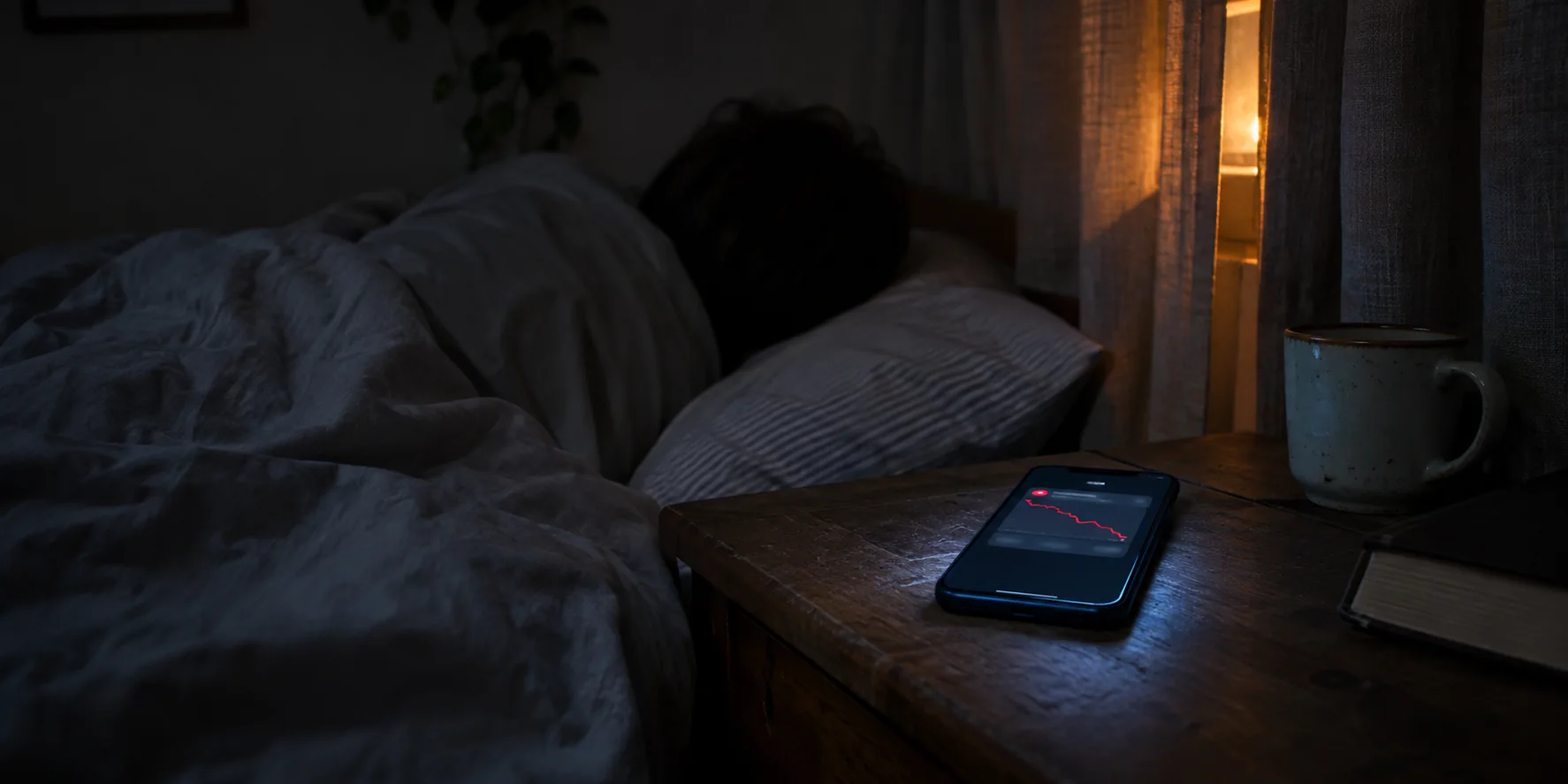
The entry triggers on Tuesday afternoon. At 2:47 a.m. on Wednesday, the phone buzzes. Price has slipped back inside the range. The 4-hour candle closes in 13 minutes. If it closes inside the range, the card says to close the position.
A lot happens in those 13 minutes. Last time I sold here, it bounced right away. There's still time before the close. If I take this loss, the whole week goes red. Two minutes before the close, the trader decides to give it more room and sets a new stop below the bottom of the range. The candle closes inside the range. This time, price recovers later that night. The trader feels relieved, and the next month does the same thing again. That time, price doesn't recover.
Looking at the chart afterwards, the card was never wrong. Branch B arrived exactly as written. What broke wasn't the plan. It was those 13 minutes at 2:47 a.m.
Part 1 covered how to write a scenario. Part 2 and Part 3 covered how to choose your losses and your risk-reward. This article is about why a plan written that way breaks at the moment it matters most, and how to get through that moment. The short answer: willpower isn't it.
Your calm self and your shaken self are different people
Economist George Loewenstein called this the hot-cold empathy gap. When we're calm, we consistently underestimate how we'll behave when we're excited or afraid. Shop for groceries on a full stomach and you can't imagine how hungry you'll be next week. Shop hungry and you fill the cart with things you don't need. The person looking calmly at a chart and thinking, "Of course I'll cut it at the stop," is not the same person standing at that stop.
Knowing about the gap doesn't close it. If you're reading this and thinking, "I know this now, so I'll be fine," that thought is the gap. Knowing something and doing it in the moment are completely different things. So the way to keep a plan isn't to persuade your future self in the moment. It's to leave that self nothing to decide.
Losses hurt more than gains feel good
According to research by Daniel Kahneman and Amos Tversky, people tend to feel a loss about twice as strongly as a gain of the same size, though the exact ratio varies from person to person. That's why a stop doesn't feel like saving $100. It feels like locking in a $100 loss. A loss you haven't taken yet doesn't quite feel like a loss, and it seems like it might go away if you wait.
That feeling pushes trading habits in one direction. Economists Hersh Shefrin and Meir Statman named it the disposition effect: we rush to take profits before they disappear, and we hold on to losses to avoid making them real. Terrance Odean found the same habit in the trading records of 10,000 accounts at a brokerage. Investors sold their winning stocks noticeably more often than their losing ones. Yet the winners they sold went on to do better over the following year than the losers they kept.
The leaking risk-reward from Part 3 is this habit, written in numbers. Winners get closed before the target and shrink. Losers slide past the stop and grow. The win rate doesn't change, but the expectancy drops below zero.
Conviction makes the stop harder
The moment you say "it's going up," you start noticing only the evidence that agrees with you. Psychologists call this confirmation bias. When price moves against you, it looks like a temporary shakeout, and taking the stop starts to feel like admitting you were wrong. The more firmly you believe your forecast, the harder the stop becomes.
That's why the days you feel most certain are the most dangerous. The stronger the conviction, the more you want to size up, widen the stop, and wave away the evidence against you. It's also why, on the Part 1 card, your prediction takes up only one line: the entry condition. Being wrong is expensive. Refusing to let go of being wrong is far more expensive.
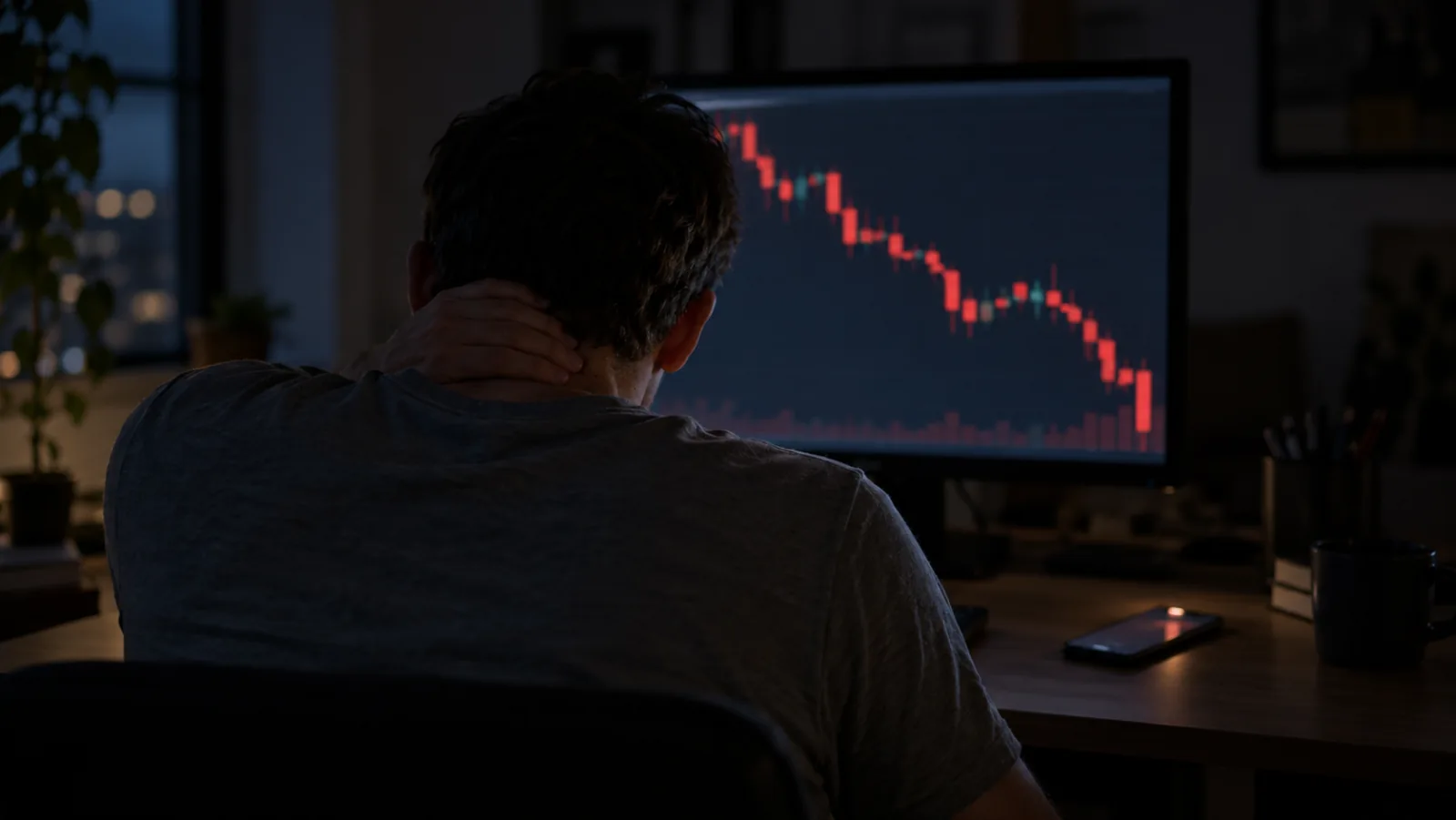
The moment price is whipsawing is the worst possible time to make a good decision.
The price that sometimes comes back is the most dangerous
The first time the trader in the opening moved the stop, price came back. That was the worst possible outcome. Getting rescued by a moved stop only has to happen once or twice in ten tries to leave a deep mark. Psychologist B. F. Skinner showed that behavior rewarded occasionally and unpredictably is especially hard to break. It's the same mechanism that keeps people at slot machines.
The numbers make it plainer. Say you ignore your stop ten times. Nine times, price comes back and you get out at break-even instead of taking a $100 loss. Each one feels like a save. On the tenth, price keeps falling, you average down as in the opening of Part 2, and the loss reaches $2,295. Across the ten trades, you've lost $2,295. Taking all ten planned stops would have cost $1,000. Nine saves, and you're still about $1,295 worse off.
So if moving the stop saved you this time, it isn't evidence that the plan was wrong. More likely, it's a preview of the next big loss.
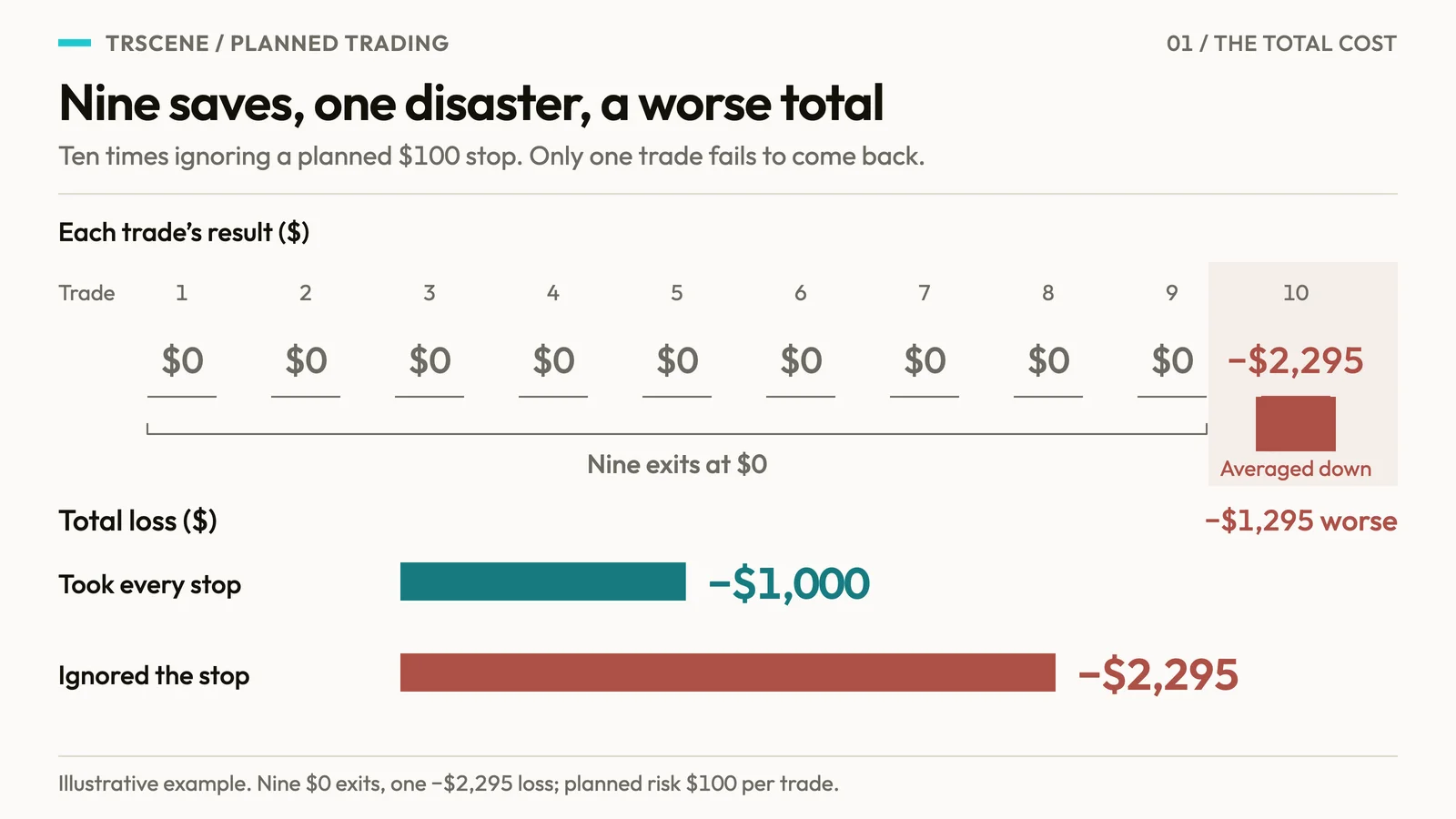
Nine saves and one disaster. Ignoring the stop can feel right most of the time and still cost more.
The moment comes in a few familiar shapes
The moments that break a plan repeat themselves in a surprisingly small number of shapes. If you know them in advance, you can write the answers in advance.
| The moment | The voice in your head | The answer to write on the card |
|---|---|---|
| Right at the stop | "Just a little longer." | The stop never moves further away. Only stop moves already written on the card happen. If your view has changed, close the position and write a new card. |
| Right after a loss | "Let's win it back now." | After three losses in a row, no new entries today (the example from Part 2). |
| After a winning streak | "I'm on a roll. Go bigger." | Risk per trade stays the same during a streak. Size up only after reviewing the record (Part 5). |
| A rally you missed | "I have to get in now." | No entry unless the entry condition is met. Missed opportunities come back. |
| Wobbling while in profit | "Let's lock something in." | Take profits only at the levels and percentages on the card (Part 3). |
| Tired, asleep, or away | "I'll just check before bed." | Set the plan up so it runs without you watching. |
All six have one thing in common. Each one urges you to make a new decision, right now. The days a plan holds are the days there's nothing left to decide.
Alerts summon the moment
The 13 minutes in the opening started with a phone alert. If the exit had been set up to run on its own and left alone, there would have been nothing to decide at 2:47 a.m., and the position would have been closed as the card said. Moments don't only come from the market. They also come from how often we look at it.
Economists Shlomo Benartzi and Richard Thaler described myopic loss aversion: loss aversion combined with checking results over short periods. Over short stretches, price moves up and down almost like a coin flip. The more often you look, the more often you see red, and someone who feels losses twice as strongly gets shaken that much more often. With the same plan and the same outcome, a trader who checks every minute lives through far more "moments" than one who checks once a day.
So if a position already has its stop and target in place, most price alerts are unnecessary. What you need is a notice that something was executed, not a price alert that calls you in to decide. Turning off one alert often does more than ten acts of willpower.
Structure instead of willpower
Willpower is weakest exactly when you need it most: in the middle of the night, right after a loss, when you're tired. So instead of trying to make your in-the-moment self stronger, reduce what that self has left to decide.
Finish the decision in advance. This is the "if X happens, I will do Y" shape from Part 1. Psychologist Peter Gollwitzer showed that people who tie an action to a specific cue follow through more often than people who only set a goal. A meta-analysis he ran with Paschal Sheeran, combining 94 independent tests, found the effect to be sizable on average. When what to do is already decided, the moment calls for execution, not judgment.
Write the failure story first. Psychologist Gary Klein suggests that before starting a project, you imagine it has already failed and write down why. He calls it a premortem. For a trade, it looks like this: before you enter, write one line answering, "If I broke this plan, when would it have been, and why?" Most of the time you already know: in the middle of the night, right at the stop, after a losing streak. That one line pushes you to write the answer for that moment onto the card.
Place the orders when you enter. If your stop and target go onto the exchange the moment you enter, the only job left for your in-the-moment self is not to touch them.
Decide the rules for changing the plan, too. Don't change the plan while you're holding the position. If your view has genuinely changed, close it and write a new card. Change the plan itself only between trades, after looking at the record. That's where Part 5 picks up.
Make the moment smaller. If the loss at your stop is big enough to cost you sleep, no structure will hold. The 1–2% risk per trade from Part 2 is a calculation, but it's also a way of shrinking the pressure of the moment to something you can bear.
Set rules for stopping. A daily loss limit, or a break after consecutive stops, decides in advance when you're done, and leaves less room for "just one more."
Record the moments you wobbled. When a trade ends, write one line next to the result: Did I follow the plan? If not, what did the voice in my head say? When the same voice shows up three times, it isn't a coincidence. It's a weakness, and a place to write an answer on your next card. How to use the record to separate the plan from its execution is the subject of Part 5.
Odysseus and the mast
Odysseus understood this problem long ago. He wanted to hear the Sirens, whose song was said to lure sailors to their deaths. So he had his crew plug their ears with wax and tie him firmly to the mast, and he gave them an order in advance: whatever I say, do not untie me. He didn't trust the version of himself who would be hearing the song. Instead, before that moment came, he made it impossible for that version of himself to undo the decision. Behavioral economists call this precommitment.
What is a trader's mast? The basic version is placing stop-loss and take-profit orders on the exchange the moment you enter. But look at the Part 1 card again: a stop judged on a 4-hour close, a time condition that closes the trade after 24 hours, moving the stop on the remainder to entry after taking half off. Basic exchange orders can't capture all of these branches. In the end, someone has to watch the screen, and that someone is usually you, at your shakiest.
Crypto makes the problem bigger. Stock markets close; Bitcoin doesn't stop on weekends or at 3 a.m. Big moves often break out while people are asleep or over thin weekend markets. It's no accident that the 13 minutes in the opening arrived at 2:47 a.m.
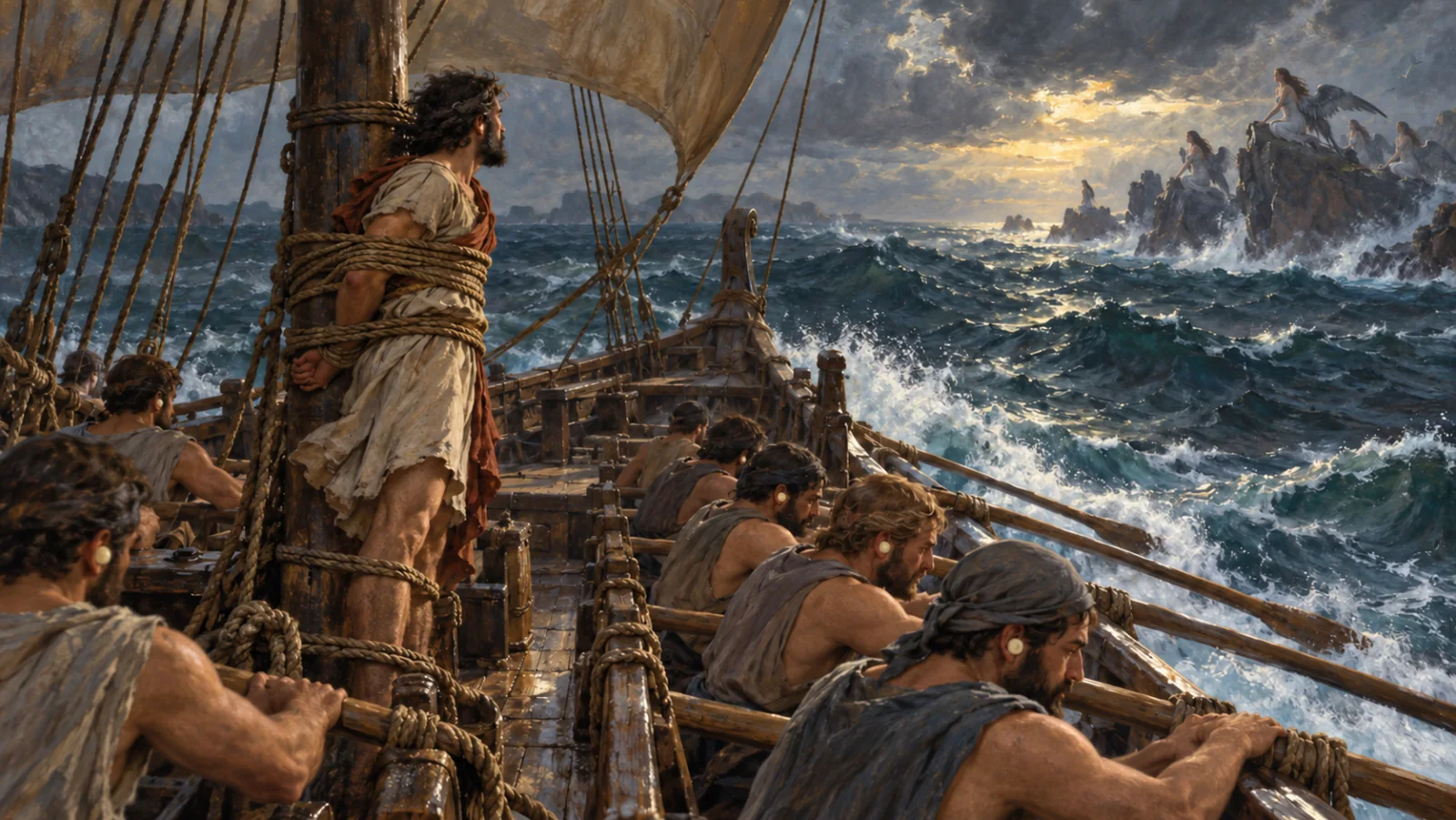
Odysseus didn't trust the man who would be hearing the song. So he tied himself down before that moment came.
TRScene as your mast
TRScene was built to be that mast. You connect entry conditions, take-profits and stop-losses, stop moves, and time limits as a single flow. Start it, and the app follows the flow on your connected exchange. The one condition is that the app stays open and the computer stays awake and connected. Nothing in the plan is left for you to decide at 2:47 a.m.
You're still in control. You can change or stop a running scenario: in the Properties panel, a change to a live order goes through when you click Apply, and you can also drag an order line on the chart. So the rule against unplanned edits still has to be yours. What TRScene changes is the default: doing nothing means following the plan. And if you set a daily loss limit, TRScene asks you to confirm before starting a new scenario once today's realized losses reach or approach it.
Willpower still counts. With the plan already running, you just need far less of it when the moment comes.
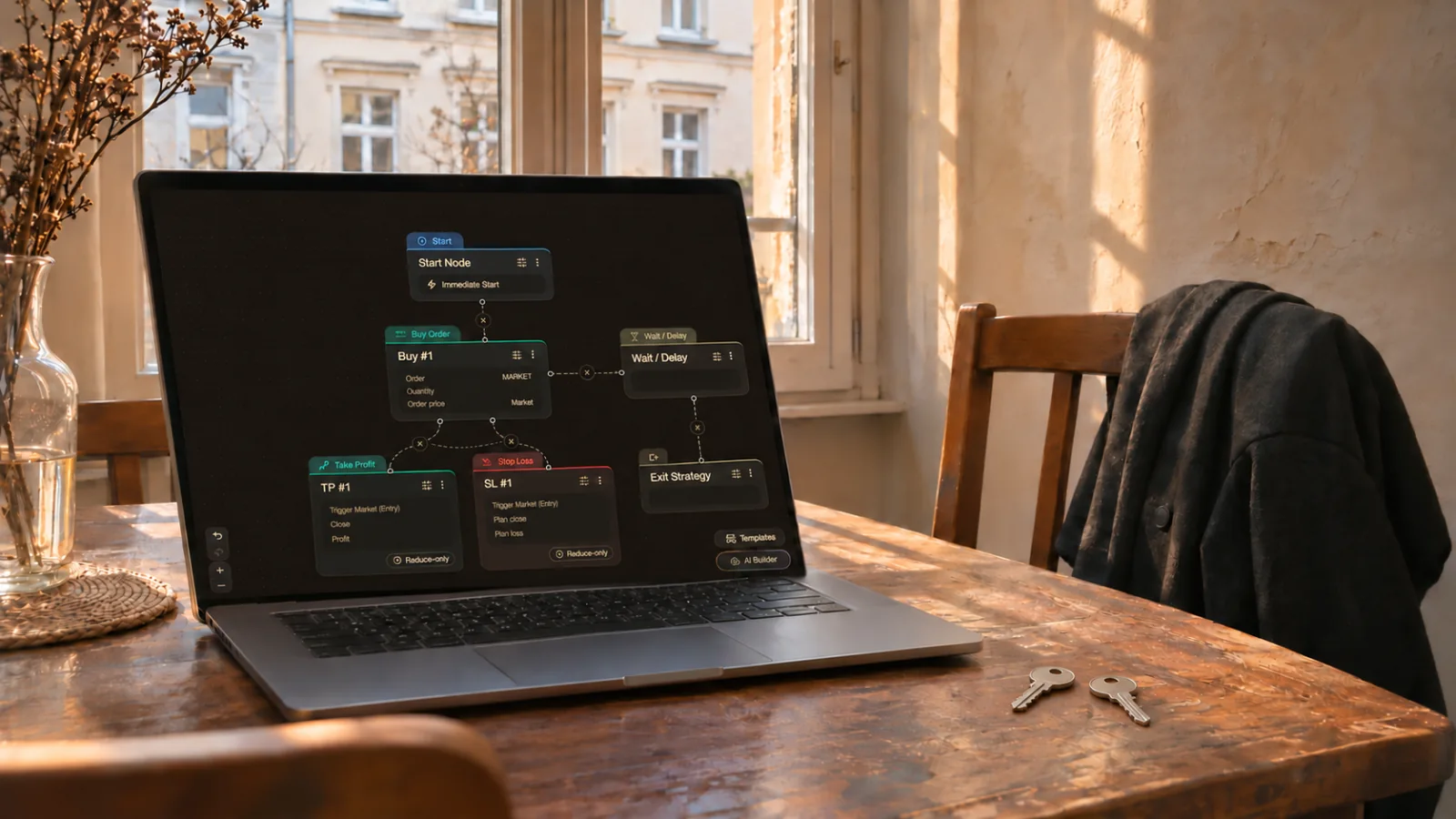
Set the plan up while you're calm, then let it run without you watching, as long as the computer stays awake and connected.
Before your next entry
Before your next trade, add these five lines to your card.
- When will I be most shaken during this trade? (The moment)
- What will the voice in my head say then? (The voice)
- Is the answer for that moment already on the card? (The answer)
- Does the plan run even if I'm not watching? (Structure)
- If I want to change the plan, have I decided when and how? (Rules for change)
You write the plan while you're calm, for the version of you who will be under pressure. When that plan breaks, it's usually not because the plan was wrong. It's because you left the moment a seat at the table.
Your plan wasn't wrong. The moment was. Next time, leave it nothing to decide.
Planned Trading series
- Previous: Part 3: Why a 40% Win Rate Can Still Make Money
- Next: Part 5: Judge the Plan, Not the Outcome
This article explains a trading approach for educational purposes and is not investment advice. The numbers in it are illustrative examples. Crypto futures and leveraged trading can lead to large losses in a short time, so only trade with money you can afford to lose.