Don't Predict. Prepare.
What scenario trading really is, why traders who prepare outlast traders who predict, and how to write your first scenario card before you enter a trade.


Planned Trading series · Part 1
It's 2 a.m. and Bitcoin drops 6% in an hour. Two traders are long Bitcoin from the same entry price.
The first trader is glued to the chart. Is this the bottom, or is there more to come? They scroll the news and refresh the forums, and every time price closes in on the stop, they nudge the stop a little lower. Every time I sell here, it bounces. By sunrise, the loss is three times what they originally planned to risk.
The second trader left a note on the day they entered: "If a 4-hour candle closes below the previous low, close everything. The planned loss at that point is about 1% of the account." When a 4-hour candle closed below that low, they closed the position as written and went back to sleep.
Neither of them saw the crash coming. Neither of them called the direction. What separated them wasn't forecasting skill. It was one thing: whether they had decided in advance what to do if they were wrong.
This article is about the second trader's way of working: scenario trading. We'll look at what it is, why preparation beats prediction, and how to actually write a scenario before you enter a trade.
Why we cling to prediction
The moment you open a chart, the first question that comes to mind is almost always the same: up or down?
Everything around you feeds that question: breakout calls in video thumbnails, year-end price targets, communities splitting into bulls and bears every morning. Prediction is entertaining, and being right feels great. Before long, trading starts to feel like a guessing game.
Yet prediction has a poor track record. Psychologist Philip Tetlock tracked roughly 28,000 forecasts made by 284 political and economic experts over nearly two decades. The results were humbling. The experts often struggled to beat simple statistical benchmarks, and the ones most confident in a single big theory tended to do worse.
Markets are harder still. If you've read the news, so has everyone else, and in the short run prices are pushed around by liquidation cascades, thin liquidity, and one-line announcements. Consistently calling the next few hours is close to impossible.
Here's the more painful part: you can be right about direction and still lose money. You expect a rally, enter too early, get stopped out, and watch price go exactly where you said it would. Or your position is too large to survive a brief dip, and you get liquidated before the move you predicted.
In the end, what separates profit from loss isn't the prediction itself. It's what you did when you were wrong, when you were right, and when the market did neither.
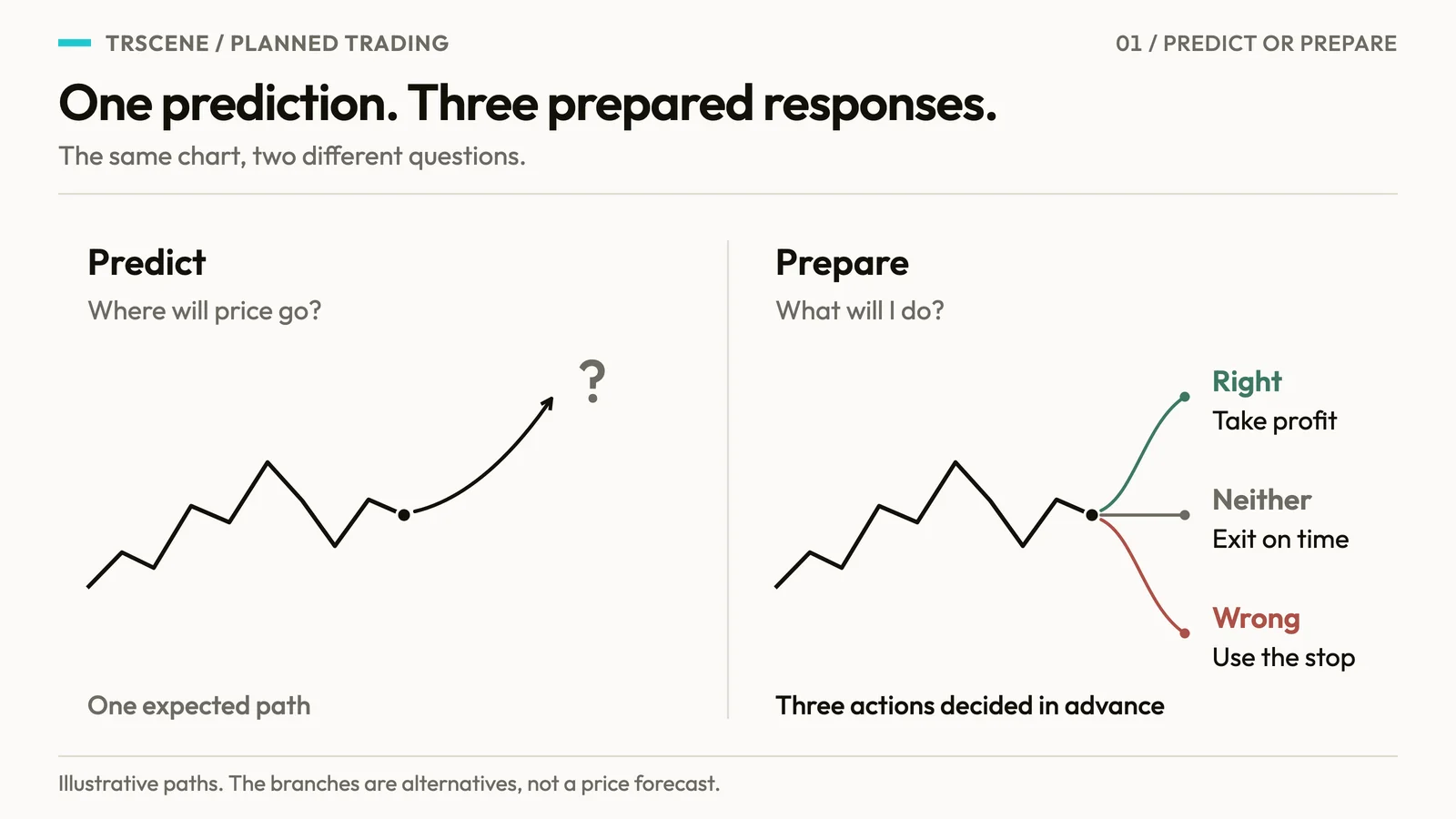
Prediction bets on one direction. Preparation decides what to do on every branch.
Change the question, change the trade
Scenario trading starts by changing a single question. Instead of asking "Where is it going?", you ask "Wherever it goes, what will I do?"
That question was in use long before trading. Dwight D. Eisenhower, who commanded the Allied forces in World War II, put it this way:
Plans are worthless, but planning is everything.
— Dwight D. Eisenhower, in a 1957 speech
On the battlefield, no plan survives intact. Armies plan anyway, because planning forces them to walk through what might happen, one situation at a time. When things go sideways, they've already walked that branch once.
Aviation works the same way. Pilots don't predict whether an engine will fail today. Their checklists lay out what to do, and in what order, if it does, so in the most urgent moment they act on procedure instead of improvising.
You see the same thing in everyday life. When the forecast says there's a 60% chance of rain tomorrow, you don't agonize over whether it will actually rain. You just bring an umbrella. If it rains, you open it. If it doesn't, it stays in your bag all day. The person who brought the umbrella didn't predict the weather. They simply made sure they'd be fine either way. In trading, a scenario is that umbrella.

The person with the umbrella didn't predict the weather. They just made sure they'd be fine either way.
Scenario traders don't give up on having a view. You're welcome to have opinions about the market. "I think it breaks resistance this time" is a fine place to start. The difference is that a scenario trader builds the possibility of being wrong into the plan from the beginning. A plan that only covers being right is less a plan than a hope.
What scenario trading is
Let's start with a definition.
Scenario trading means splitting the paths the market could take into a few branches before you enter, and deciding in advance what you'll do on each one.
Every scenario is made of three parts:
- Conditions: When does this plan begin? What price or signal tells you to enter?
- Branches: The paths the market can take once you're in: you're right, you're wrong, or it's neither.
- Actions: What you'll do on each branch: where you exit, how much, and how.
Written out, these three parts always take the same shape: "If X happens, I will do Y."
That simple sentence structure has solid research behind it. Psychologists call it an implementation intention, and people who tie an action to a specific cue follow through far more often than people who only set a goal. When the moment to decide arrives, the decision has already been made, and there's less room for mood, fatigue, or fear to creep in.
Scenario trading isn't a new invention. Traders who last have always done some version of it, under names like a trading plan or a pre-entry checklist: before money is on the line, they decide what they'll do once it is. Scenario trading adds the structure of branches, turning a plan from a single straight line into a map.
Putting prediction-driven trading and scenario trading side by side makes the difference clearer.
| Prediction-driven trading | Scenario trading | |
|---|---|---|
| Starting question | Where is it going? | Wherever it goes, what will I do? |
| Reason to enter | Conviction | A condition set in advance |
| When you're wrong | Decide in the moment | A stop already in place |
| Size of the loss | Known only at the end | Known before entry |
| When you decide | While price is moving | Before you enter |
| How you review | Was I right? | Did I follow the plan? |
Writing your first scenario card
A concept sinks in fastest when you write it out yourself. Let's work through a common setup.
Bitcoin has spent three weeks moving inside a fixed price range. It has been rejected at the top of the range three times and has bounced off the bottom three times. In other words, it's ranging. Your view: "This time it breaks out to the upside."
A prediction-driven trader buys right here. A scenario trader picks up a pen first.
| Scenario card: BTC range breakout (long, example) | |
|---|---|
| Entry condition | Go long when a 4-hour candle closes above the top of the range. |
| Invalidation | If the bottom of the range breaks before the top does, drop the plan and do nothing. |
| Branch A: right | Take half off when price rises by the height of the range. Move the stop on the other half up to the entry price. |
| Branch B: wrong | If price falls back inside the range and a 4-hour candle closes there, close the whole position. |
| Branch C: neither | If neither A nor B happens within 24 hours of entry, close the position. |
| Size | Size the position so that branch B costs 1% of the account. |
Six lines. Yet those six lines cover nearly everything that can happen in this trade.
The numbers are already in place, too. With a $10,000 account, 1% is $100, and if the stop is 2% from entry, the position size is $100 divided by 2%, or $5,000. If the range is 6% tall, the first target is +6% against a −2% stop: a 1:3 risk-reward ratio. How to choose those numbers is the subject of Part 2 and Part 3. The point here is that the math is done before you enter.
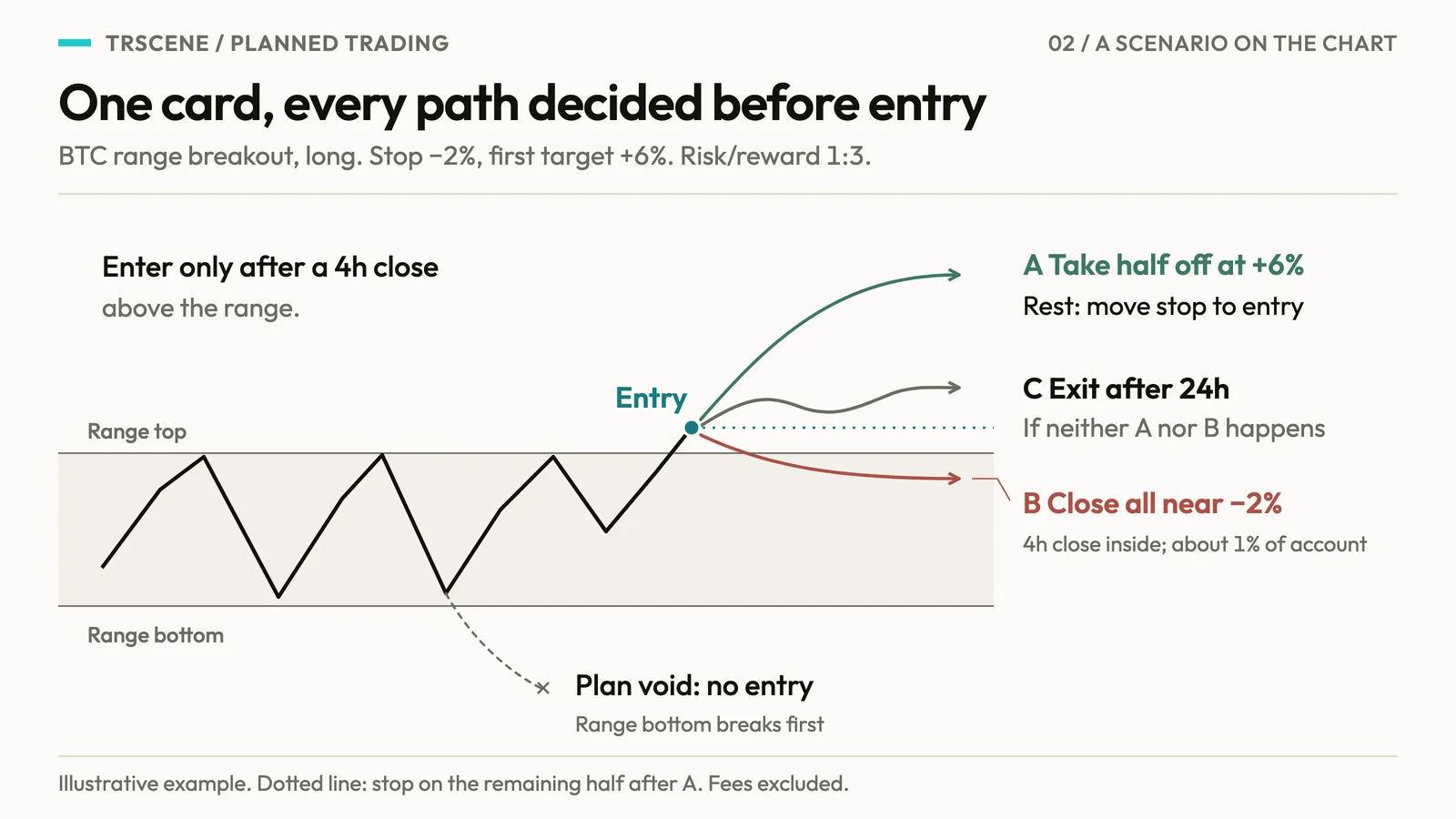
The scenario card on a chart. After half the position is taken off at A, the stop on the rest moves up to the entry price (dotted line).
Notice the most important thing about this card. Your prediction, "I think it breaks out this time," survives as a single line: the entry condition. The other five lines set the exits, the size, and when to drop the idea. Most of the page is about what you'll do, not what you think will happen.
One card, three endings
Let's follow the card through three possible endings.
Ending one. Tuesday afternoon, a 4-hour candle closes above the top of the range. The entry condition is met, and you go long. The next morning, price rises by the height of the range and hits the first target. You take half off and move the stop on the remaining half up to your entry price. From here, if the stop on the rest fills at entry, the trade finishes in profit, before costs. The rest of the position can ride as far as the market will take it.
Ending two. Same Tuesday, same entry. But early the next morning, price slides back into the range, and a 4-hour candle closes below the top. That's branch B. You close the whole position for a loss of about $100, roughly 1% of the account. It doesn't feel good, but the loss stayed within the size you chose, and the other 99% of your account is ready for the next opportunity.
Ending three. You're in, but price spends the whole day hovering around the top of the range. After 24 hours, branch C tells you to close. It ends in a small gain or a small loss. More important than the money: the margin and attention that were tied up are free again, so you can look for the next opportunity.
In all three endings, you did the same thing: you followed the card. The only difference was which path the market chose, and that was never yours to choose. In scenario trading, you're responsible for the quality of the card, not for the ending.
Experienced scenario traders often write the opposite card, too: a short entry if a 4-hour candle closes below the bottom of the range. Then, whichever way the range resolves, they have something to do.
Three marks of a good scenario
Anything you write down counts as a scenario. But the ones that actually get followed, and that help when they are, share a few traits.
A condition with only one possible answer
"Sell when it's up a lot" isn't a condition. The answer depends on how you feel in the moment. A good condition gives the same answer no matter who's looking: "a 4-hour candle closes above the top of the range" leaves no room for debate. The vaguer the condition, the more you'll judge again in the moment, with emotion.
A stop where you're proven wrong
A good stop sits where the market shows that your idea was wrong, not at a round number you picked first. For this breakout plan, that's a 4-hour candle closing back inside the range. Choose the stop first, then size the position to fit it.
A size you can actually live with
The amount you'd lose at the stop should be small enough that you can still sleep. If it isn't, even a well-written scenario becomes hard to follow when the moment comes. That's why many traders risk only 1–2% of their account on a single trade.
What one card gives you
A single scenario card gives you four things. Each gets its own article in this series.
You choose the size of your loss before you enter. In the example above, the planned loss is about 1% of the account. Accounts rarely blow up from one bad call. They blow up from a chain of unplanned decisions: moving the stop, averaging down, jumping back in to win it back. (Part 2)
You get a risk-reward ratio. You can only measure risk-reward once a target and a stop exist. With it, a strategy that wins only 40% of the time can still make money. (Part 3)
You decide while you're calm. The moment price is whipsawing is the worst possible time to make a good decision. A scenario finishes the decision before that moment arrives. (Part 4)
You get something to review against. After a trade made without a plan, there's nothing to say except "bad luck" or "I knew it." With a scenario, you can ask better questions: Did I follow the plan? Was the plan any good? (Part 5)
Three misconceptions about scenario trading
People new to scenario trading often fall into a few traps.
"If I write enough scenarios, I'll get them all right"
The goal isn't to be right. It's to know what to do whichever path the market takes. Ten or twenty branches won't make you more accurate; they just make the plan harder to follow. For most trades, three branches are enough: right, wrong, and neither. A good scenario can be explained in a single sentence.
"It's better to stay flexible and read the situation"
Flexibility belongs in the plan, as a branch. "If volume is far above normal, raise the target one level" is flexibility you wrote down in advance, and it's part of the plan. Moving your stop on impulse mid-trade isn't flexibility. It's wavering. If your view has genuinely changed, close the position and write a new scenario.
"Waiting for conditions means missing opportunities"
True. Scenario traders regularly miss rallies that never met their conditions. But those weren't missed; they were declined. Without entry conditions, every move looks like an opportunity. Missed opportunities come back. Lost capital doesn't come back on its own.
Writing the plan is easy. Keeping it is hard.
Many traders do write plans, in notebooks, spreadsheets, or notes apps. The trouble isn't the plan. It's the execution: the "just a little longer" right before your stop, the sudden move while you're asleep or driving. A plan on paper has no power in those moments. Plans don't execute themselves.
In crypto, the problem is bigger. Bitcoin doesn't stop on weekends or at 3 a.m., and big moves often break out while people are asleep. If keeping your plan depends only on your own eyes and willpower, your plan is only valid while you're awake. Why the moment beats the plan, and how traders tie themselves to the mast, is the subject of Part 4.
Why we built TRScene
This is exactly why we built TRScene.
Writing the scenario is the trader's job. Reading the market and preparing for being wrong is judgment, and that judgment is your skill. But following the scenario exactly as written, without emotion, is something a machine does better than a person.
In TRScene, a scenario is a flow on a canvas. You connect entry conditions, orders, take-profits and stop-losses, stop moves, and time limits as nodes, branch by branch, so the card above becomes a single flow. When you start it, the app places and manages orders on your connected exchange (OKX, Binance, or Bybit), following that flow step by step. You can run the same scenario in each exchange's Demo environment before real money is on the line, and every run leaves a record so you can put the plan and the reality side by side.
One thing to know before you rely on it: TRScene carries out a scenario from the app on your computer. It does that only while the app is open and the computer is awake and online. If you want a scenario to keep going overnight, that computer has to stay on and connected.
We also want to be clear about what TRScene doesn't do. TRScene doesn't predict the market. It doesn't decide which scenario is good for you. It helps you carry out, at your shakiest, the decision you made at your calmest.
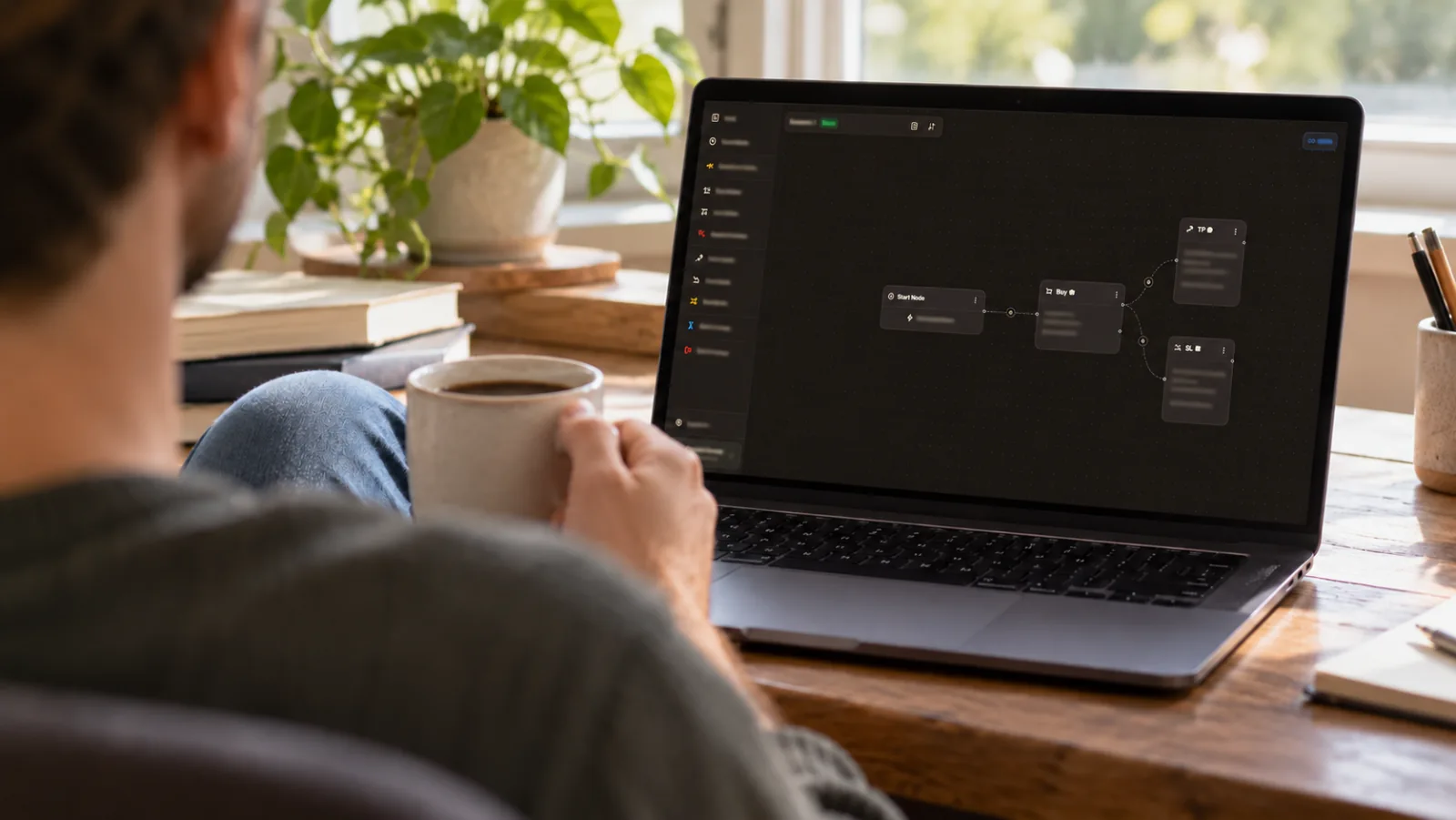
You make the decision while you're calm. TRScene handles the execution.
The next time you open a chart
The next time you open a chart, before you ask "Where is it going?", try answering these six questions first. A single sheet of paper is enough.
- What will I see that tells me to enter? (Entry condition)
- What will I see that tells me my idea was wrong? (Stop)
- If I'm right, where do I take profit, and how much? (Target)
- If nothing happens, how long will I wait? (Time limit)
- If I'm wrong, what percentage of my account do I lose? (Size)
- In what situation will I not enter at all? (Invalidation)
If you can't fill in all six lines, it isn't time to enter yet.
For the first few weeks, try writing this card by hand for every trade. You'll find that far more trades fail to fill all six lines than you'd expect, and that skipping them is itself a form of training. Before long, before you see where price might go, you'll see where your idea would be proven wrong.
The market will keep surprising us. There's no way to avoid being surprised. But what you'll do in that moment is something you can decide right now. That's all scenario trading really is.
Don't predict. Prepare.
Planned Trading series
This article explains a trading approach for educational purposes and is not investment advice. The numbers in it are illustrative examples. Crypto futures and leveraged trading can lead to large losses in a short time, so only trade with money you can afford to lose.