You Can't Avoid Losses. You Can Choose Them.
Accounts rarely break on planned losses. They break on the ones nobody planned. How to choose a loss before you enter: stop first, then risk, then size, and why that habit carries you through losing streaks.


Planned Trading series · Part 2
Let's look at one trader's month. The account is $10,000, and there are twenty trades.
Thirteen of the twenty were winners, a 65% win rate. The winners made $90 on average, and the six losers each lost $100, right where the stop was set. After nineteen trades, the month stood at +$570. Not a bad month.
The problem was the last trade. The plan started out like every other one: buy $5,000 worth, set a stop 2% below, and lose $100 if wrong. But when price reached the stop, the trader moved it. At −4%, they bought the same amount again. Lowering the average price seemed like a way to get out on even a small bounce. At −8%, they bought $10,000 more. At −16%, they couldn't take it anymore and closed everything.
That one loss was $2,295, twenty-three times the loss they had planned. The month finished at −$1,725, or −17% of the account.
This trader didn't need a better entry signal. Nineteen trades went fine. What broke was the habit of deciding the size of a loss in advance and sticking to it.
In Part 1, we described scenario trading as deciding what to do on every branch before you enter. This article is about the most important line on that scenario card: how much you lose if you're wrong.
Two kinds of losses
Losses in trading come in two kinds.
A planned loss is decided before you enter. You know where you'll get out if you're wrong, and you know what it will cost. When it happens, it stings a little, and then it's over.
An unplanned loss is built after you enter, one decision at a time. Here is the trade from the opening, broken down decision by decision.
| Price | The decision in the moment | What it sounded like | Loss so far |
|---|---|---|---|
| −2% | Move the stop | Every time I sell here, it bounces. | −$100 |
| −4% | Buy $5,000 more | Lower the average price. | −$200 |
| −8% | Buy $10,000 more | I can't sell at the bottom. | about −$610 |
| −16% | Close everything | I can't hold on any longer. | −$2,295 |
Each decision in that table sounded reasonable at the time. But every one of them was made while losses were piling up and the pressure was rising, and every one of them pushed the risk higher. Moving the stop raised the amount that could be lost. Adding to the position raised the amount riding on an idea that was already wrong.
An unplanned loss isn't one big mistake. It's a chain of small, sensible-sounding decisions. What separates it from a planned loss isn't the size. It's when the decision was made: one was made while calm, the other while losing money.
Why is it so hard to stop at the stop? The most common reason is getting anchored to the entry price. The moment price touches the stop, the question in your head changes from "Was this trade wrong?" to "How far is it back to break-even?" Break-even means nothing to the market. Price has no idea where you bought. Yet we refuse to leave until it comes back to that number. Averaging down comes from the same place: it drags break-even closer. The price is that the money riding on a wrong idea grows from $5,000 to $10,000, then to $20,000.
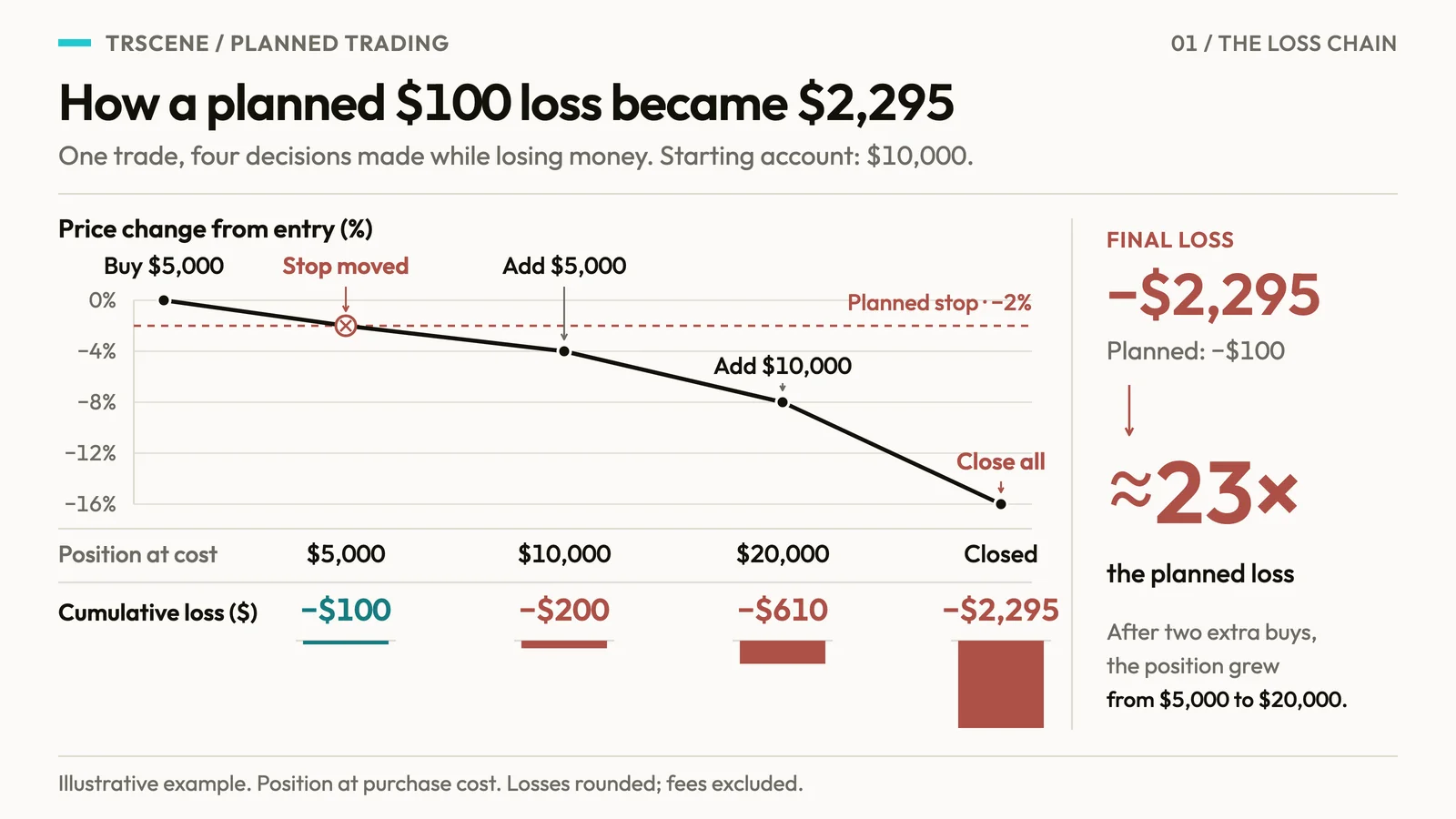
How a planned −$100 loss turned into −$2,295, one reasonable-sounding decision at a time.
Losing streaks will come
Even a trader who only takes planned losses will lose several times in a row. Losing streaks don't have to mean bad skill. They also come from how probability works.
Take a strategy that wins half the time and trade it 100 times. The chance that somewhere in those 100 trades you lose five in a row is about 81%. Seven in a row: about 32%. With a 40% win rate, five in a row becomes about 98%, and eight in a row about 49%. As we'll see in Part 3, a 40% win rate can make good money with the right risk-reward ratio. Even a strategy like that goes through stretches like these; how often depends on how much you trade.
You can't choose when a losing streak arrives. You can choose how big a hole it leaves in your account. That comes down to one number: how much of the account you put at risk on each trade.
| Risk per trade | Account after 10 losses in a row | Gain needed to get back |
|---|---|---|
| 1% | −9.6% | +10.6% |
| 2% | −18.3% | +22.4% |
| 5% | −40.1% | +67.0% |
| 10% | −65.1% | +186.8% |
The table assumes you risk the same percentage of what's left in the account on each trade. For a trader risking 1% per trade, ten losses in a row is a rough stretch. For a trader risking 10%, the same streak leaves a hole so deep that what's left has to nearly triple just to get back to the start. Both traders use the same strategy. The only difference is the size of the loss they chose before each entry.
Run the same math backwards and you get a way to choose your risk per trade. Start with a losing streak your strategy will see fairly often, then pick a risk size that lets you survive it. With a 40% win rate, an eight-loss streak shows up in about half of all 100-trade runs. At 2% per trade, eight losses in a row take about 15% off the account. At 1%, about 8%. Could you keep following the same rules after losing 15%? If the honest answer is no, your risk per trade is too high.
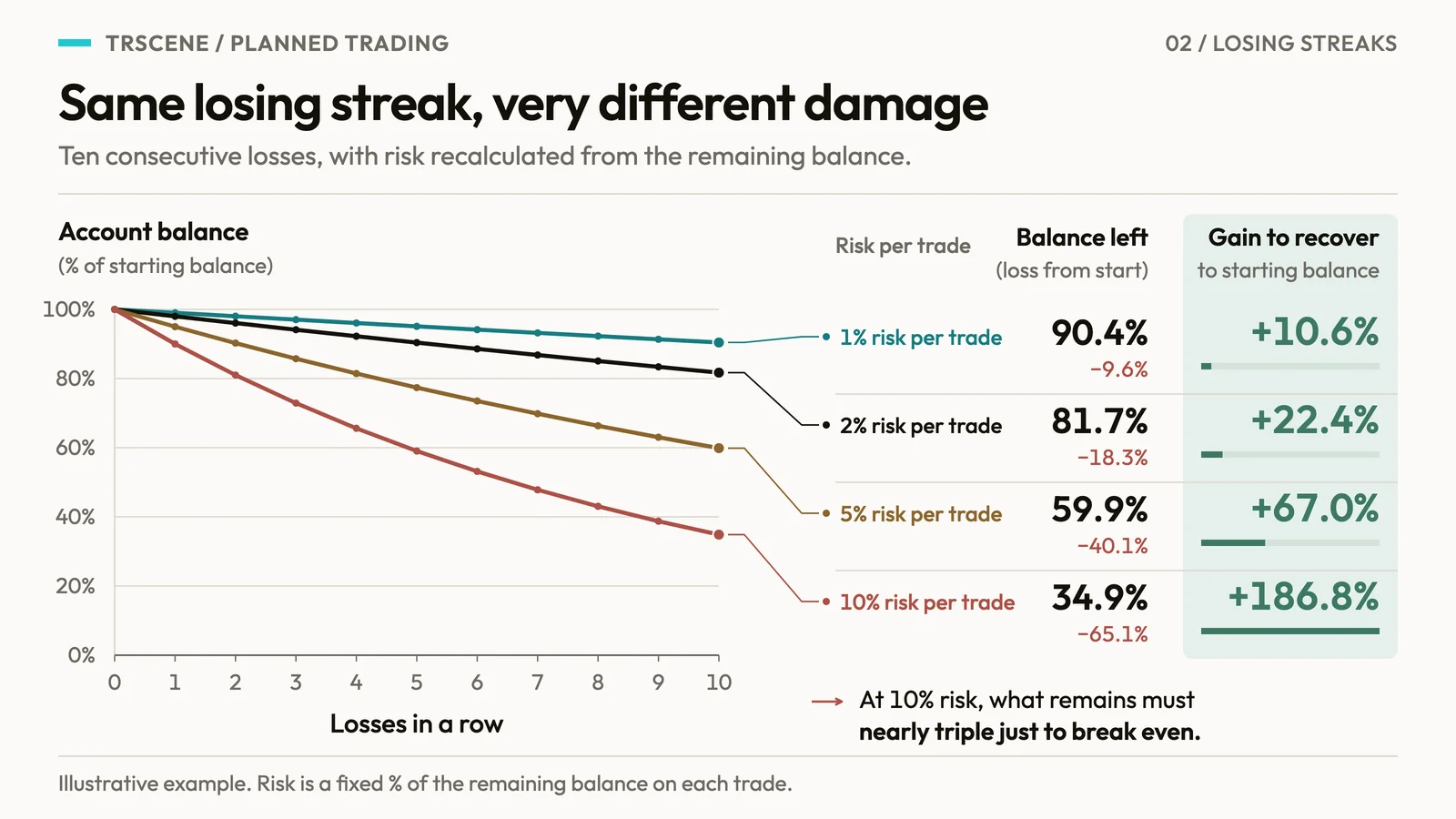
The same losing streak, four different holes. Only the risk per trade changed.
Choosing a loss in three steps
Choosing a loss isn't about resolve or mood. It's a short calculation you finish before you enter.
- Put the stop where your idea is proven wrong. Not at a round number like "if it drops 3%." Put it where the reason for the trade falls apart. For the range breakout in Part 1, that's where price closes back inside the range. For a bounce off support, it's where support breaks. For a trend trade, it's where the swing low that defined the trend breaks. Below that point, it's clear that what you expected isn't happening.
- Decide what percentage of the account you're willing to lose. Many traders use 1–2%. There's no single right number. The more often you trade, and the more positions you hold in the same direction at once, the lower it should be, because positions held together can all be wrong together. In the end there's one test: if you lost that much, would you be tempted to undo it?
- Let those two numbers set the position size. Divide the money you're willing to lose by the distance to the stop.
Here it is with numbers. With a $10,000 account and 1% risk per trade, you're willing to lose $100. If the stop is 2.5% from your entry, the position size is $100 divided by 2.5%, or $4,000. If the stop is hit, you lose about $100, before fees and slippage.
The same $100 of risk gives a different position size for every stop distance.
| Distance to stop | Position size ($100 risk) |
|---|---|
| 1% | $10,000 |
| 2.5% | $4,000 |
| 5% | $2,000 |
A wider stop means a smaller position. A tighter stop means a bigger one. The money at risk stays at $100. Position size isn't something you pick. It follows from the stop distance and the risk you chose.
The order matters. The stop comes first, and the size follows. Traders who pick the size first end up pulling the stop closer to make that size fit. Then every small wiggle knocks them out, and eventually they decide that "stops don't work" and stop using them at all. A stop placed to fit a position size isn't really a stop.
Here is the same kind of card as in Part 1, this time with a 2.5% stop instead of 2%:
| Sizing card: BTC range breakout ($10,000 account, example) | |
|---|---|
| Entry condition | Go long when a 4-hour candle closes above the top of the range. |
| Stop | Where price closes back inside the range, about 2.5% below the entry. |
| Risk | 1% of the account, $100. |
| Position size | $100 ÷ 2.5% = $4,000. |
| Leverage | 5x, so $800 of margin. Liquidation sits roughly 20% away, far beyond the stop. |
The answer to "How much do I lose if I'm wrong?" is already on the card. Wherever price goes, this trade is planned to take about $100 out of the account, plus any slippage.
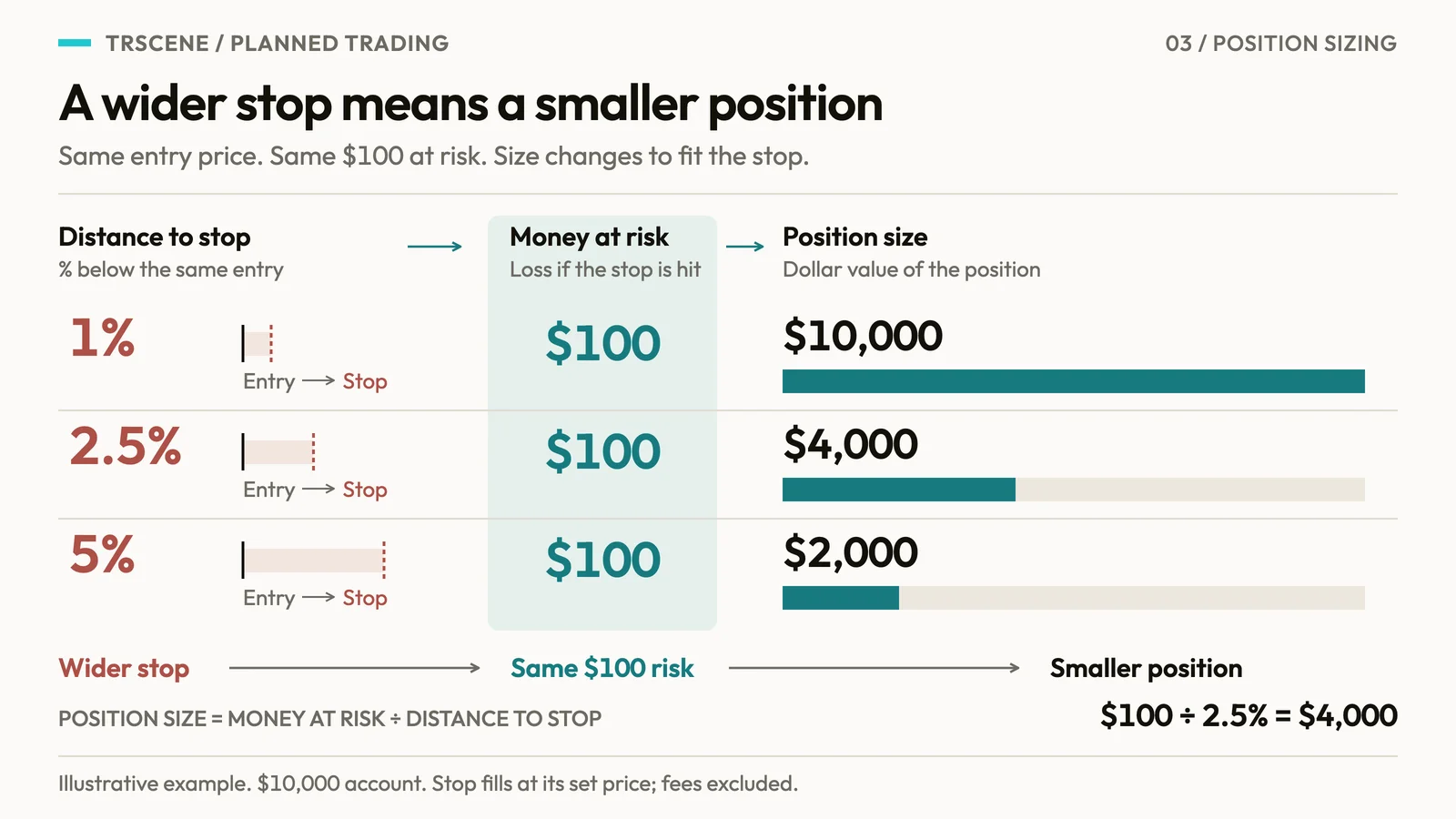
Same risk, different size. The stop sets the size, not the other way around.
Leverage doesn't decide your loss. Position size does.
People new to futures often assume 10x leverage is ten times riskier than 2x. Whether that's true depends on one thing: what you keep the same when you change the leverage.
If you keep the position size the same, the way we sized it above, leverage doesn't change your loss. What you lose at the stop comes from two things only: how big the position is and how far price moves. A $4,000 position that falls 2.5% loses about $100, whether you opened it at 2x or 20x. What leverage changes is how much of your own money the exchange sets aside for the position as margin.
| Leverage | Position size | Your margin | Loss at the 2.5% stop |
|---|---|---|---|
| 2x | $4,000 | $2,000 | $100 |
| 5x (the card above) | $4,000 | $800 | $100 |
| 20x | $4,000 | $200 | $100 |
If you keep the margin the same instead, leverage makes the position bigger, and the loss grows with it. Put $1,000 in at 2x and you hold a $2,000 position, so a 2.5% drop costs $50. Put the same $1,000 in at 10x and you hold a $10,000 position, so the same drop costs $250. That's where "high leverage is dangerous" comes from. The danger isn't the number on the setting. It's using that number to take a bigger position, and then dropping the stop to make room for it.
Leverage changes one more thing: how close liquidation is. Liquidation means the exchange closes your position for you because the margin behind it is almost used up, and the price where that happens is your liquidation price. The higher the leverage, the less margin there is, and the closer that price sits to your entry. At 20x it's roughly 5% away or a little less, so a 2.5% stop still comes first. At 50x it can be less than 2% away, and you can be liquidated before price ever reaches your stop. (These are rough figures for a simple isolated-margin position. The exact point depends on the exchange, the margin mode, and maintenance margin.)
So set things in this order: the stop first, then how much you're willing to lose, then the position size. Choose leverage last, and keep it low enough that your stop comes well before liquidation.
A stop isn't a guarantee
Setting a stop doesn't mean you'll always get out at that price. Choose your losses knowing that.
When the market moves fast, there's a gap between the moment price touches your stop and the price you actually get. This is called slippage. In thin overnight trading or right after a major announcement, a stop set at 2.5% can fill at 3% or 4%. The type of stop matters too. A stop that sends a market order when triggered will almost certainly get you out, but the price can slip. A stop that only fills near your chosen price protects the price, but in a sharp drop it can be skipped entirely and never fill.
So leave some room when you choose a loss. If you plan to lose 1% of the account, check that you could live with it even after some slippage. And skip trades where the stop has to sit very far away. If a trade only makes sense with a stop 10% below entry, a position sized for 1% risk comes to just a tenth of the account. If that size feels too small to bother with, that isn't a reason to tighten the stop. It's a reason not to take the trade.
Choose your daily loss too
Choosing the loss on each trade isn't the end of it. On bad days, losses arrive in clusters, and judgment after two or three losses in a row is worse than usual. That's when revenge trading happens: jumping into unplanned trades to win back what was lost.
That's why many traders set a daily or weekly loss limit in advance: "If I lose 3% of the account today, I'm done for the day," or "Three losses in a row and I'm done for the day." This is a planned loss too. The unit just grew from one trade to one day.
Set this rule while you're calm, because the version of you who hits the limit is the one saying "just one more." Closing the screen and walking away when you hit it is part of the plan.
There are longer-term rules as well. If the account falls by a set amount in a month, say 10%, cut the risk per trade in half from the next trade on. Risking less during a losing stretch slows the fall and buys time until the strategy starts working again. Risking more to win back losses does the opposite. It's the opening trade's averaging down, applied to the whole account.
The same thinking applies when you hold several positions at once. Each one may risk 1%, but three open together put 3% at risk at the same moment. Crypto in particular tends to move together. When Bitcoin drops hard, most other coins drop with it, so three positions in three different coins can really be one big bet. Put a cap on the total risk you have open at once, too, for example 3–5% of the account.
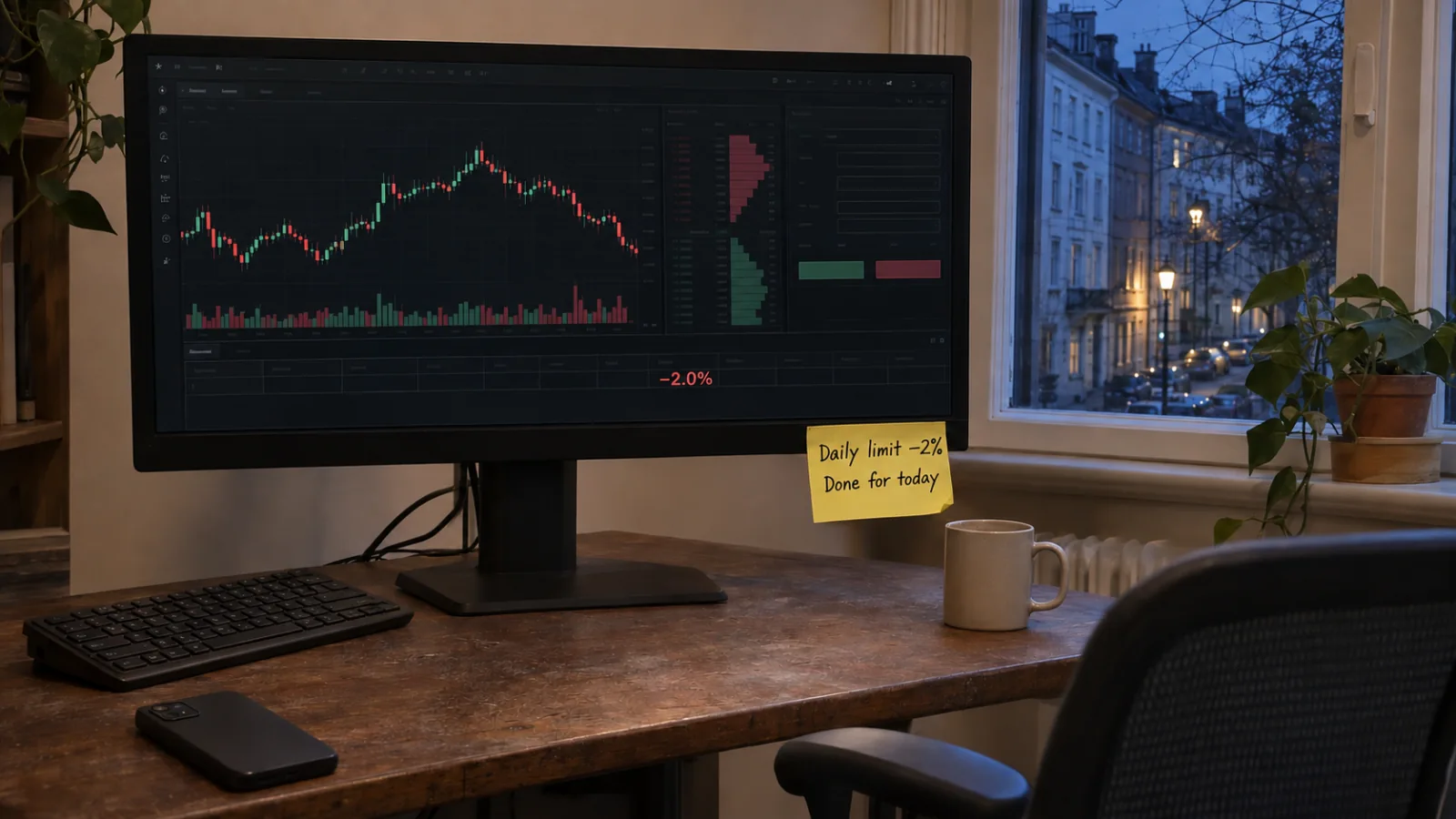
Hitting the daily limit and walking away is part of the plan.
A chosen loss hurts less
A loss you chose in advance feels different when it arrives. You already accepted it while you were calm. When it comes, there's nothing new to decide, so there's nothing to fight about.
An unplanned loss is the opposite. Every move in price forces a new decision, and every decision gets made at the worst possible moment: when you're losing money and want it back. That's when stops get moved and positions get doubled.
Firefighters sometimes start a fire on purpose. Ahead of an approaching wildfire, they burn a narrow strip of land, and when the big fire reaches that strip, there's little left to burn, which can slow or stop it. They chose to lose a small part of the forest. A planned stop does the same job: it accepts a small loss in advance so the whole account doesn't burn.
Your stop, built into a TRScene scenario
TRScene is built around this habit. In a TRScene scenario, the stop is part of the plan from the start: you connect the entry, the take-profit, the stop-loss, and any stop moves as one flow before you run it. After you start it, the app works through that flow on your connected exchange (OKX, Binance, or Bybit) while it stays open on a computer that's awake and online. It follows the stop you chose, not the one you'd want to choose in the moment.
You can choose your daily loss too. Set a daily loss limit in dollars, and when today's realized losses reach it or get close, TRScene asks you to confirm before you start another scenario. Profits don't offset those losses. You can still go ahead. The check simply gives you one pause in front of "just one more."
Where to put the stop and how much to risk are still yours to decide. Decide them before the trade, and the scenario carries that choice into the moment the loss actually shows up.
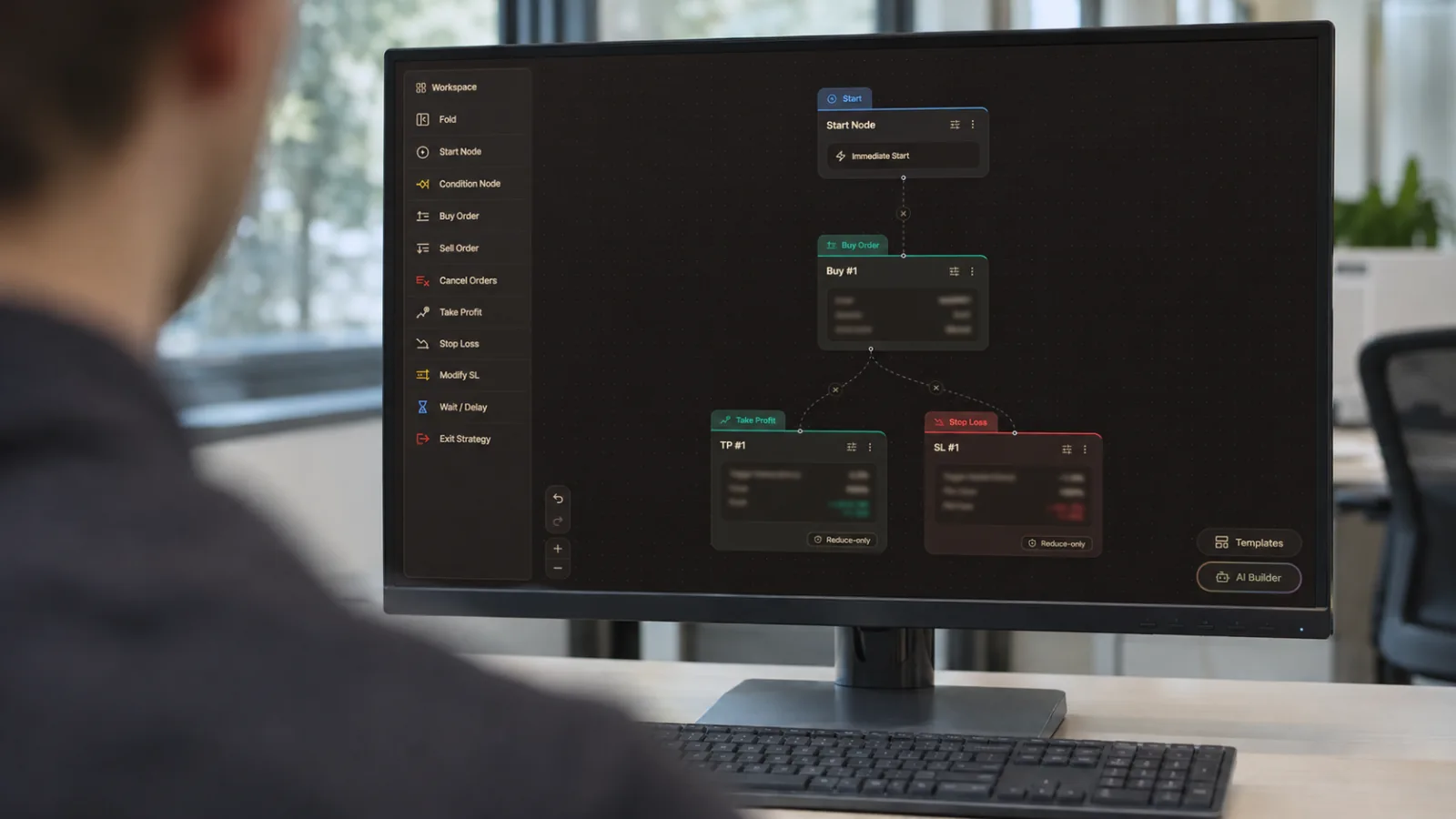
The stop is part of the plan before the trade ever starts.
Before your next entry
Before your next trade, try answering these five questions first.
- Where will I admit my idea was wrong? (Stop)
- What percentage of the account do I lose there? (Risk)
- So what's the position size? (Risk ÷ distance)
- Is liquidation well beyond the stop? (Leverage)
- How much room is left before today's loss limit? (Daily limit)
If you can't fill in all five, it isn't time to enter yet.
There's no way to avoid losses in the market. But before every entry, you get to choose which loss you'll take. More often than not, that choice is what separates the traders who last from the ones who don't.
You can't avoid losses. You can choose them.
Planned Trading series
This article explains a trading approach for educational purposes and is not investment advice. The numbers in it are illustrative examples, and the losing-streak probabilities assume each trade's outcome is independent. Crypto futures and leveraged trading can lead to large losses in a short time, so only trade with money you can afford to lose.