Judge the Plan, Not the Outcome
A good trade can lose and a bad one can win. How to judge your trading by the plan and its execution instead of the outcome: four boxes, an execution score, a normal range for bad luck, and a weekly review.


Planned Trading series · Part 5
Two trades closed on the same day.
The first trader went in without a card. When price came close to the stop, they moved the stop lower. When it dropped a little further, they doubled the position. That night, price came back, and the trade closed at a $400 profit.
The second followed the card from Part 1. The entry condition was met, the stop sat where the idea would be proven wrong, and the size was set so the stop would cost 1% of the account. Price went the other way, and the trade closed at exactly a $100 loss.
Which was the better trade? Judging by the account, the first. But imagine repeating the first trade a hundred times. Sooner or later it produces the kind of loss from the opening of Part 2. Repeat the second a hundred times, and the result follows the plan's own numbers. Whether that's a profit depends on the plan's expectancy (Part 3), but at least you'll be able to tell.
This is the last part of the series. We've covered writing a scenario (Part 1), choosing your losses (Part 2), setting your risk-reward (Part 3), and getting through the moment (Part 4). One question is left: once a trade is over, what do you judge yourself by?
Judging decisions by results
Annie Duke, a former professional poker player who now studies decision-making, calls the habit of judging a decision by its outcome "resulting." It's the central idea of her book Thinking in Bets: if the outcome was good, we believe the decision was good, and if it was bad, we believe the decision was bad.
In an uncertain game, every outcome is a mix of two things: the quality of the decision, and luck. You can't separate them from a single result. Good decisions can lose, and bad decisions can win. Over short stretches, luck has by far the bigger share. A single trade's result is mostly noise.
Yet we grade ourselves on the result of every trade. Win, and it's "I knew it." Lose, and it's "What was I thinking?" Grade yourself that way and you learn the wrong lessons. On the day you win by moving your stop, you learn to move your stop. On the day you lose by following your card, you learn to doubt your card.
Four boxes
Separate the decision from the outcome, and every trade lands in one of four boxes.
| Good outcome | Bad outcome | |
|---|---|---|
| Good plan, followed | Earned profit. Keep going. Luck still played a part. | Bad luck. Nothing to fix in this trade. Judge the plan over many trades. |
| Bad plan, or plan broken | Lucky mistake. The most dangerous box. | Earned loss. It's clear what to fix. |
"Good plan, bad outcome" isn't a failure. A planned loss is a cost of doing business. A shop pays rent; a trader pays planned stops. Following a scenario doesn't mean you always make money. What a scenario offers isn't profit. It's keeping each loss close to the size you decided on.
The most dangerous box is the lucky mistake. The first trade in the opening belongs there. The outcome was good, so there seems to be nothing to fix, and as Part 4 showed, a reward that comes only now and then makes a habit the hardest to break. Treat a trade in this box exactly like an earned loss, even if it made money. Write down what you broke, and write the answer onto your next card.
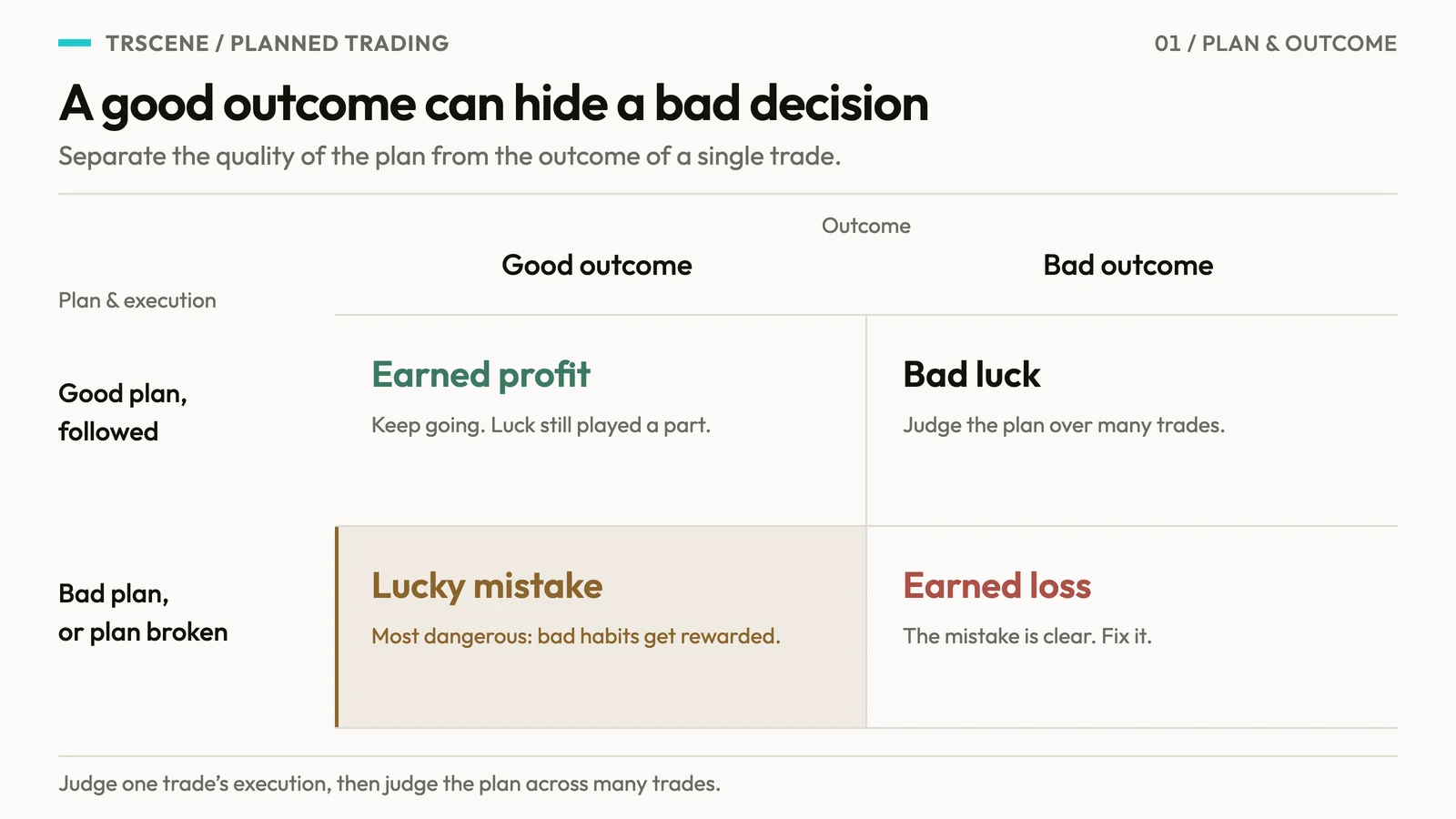
The box to watch is the one where breaking the plan paid off.
Ask two questions, separately
When a trade is over, ask two questions, and keep them apart.
First: did I follow the plan? This is a question about execution, and a single trade is enough to answer it. Did I enter when the condition was met? Was the stop where I said it would be? Did I take profits at the levels and percentages on the card? Did the size match the risk I chose? Each answer is yes or no.
Second: was the plan any good? This is a question about design, and a single trade can't answer it. As Part 3 showed, win rate, average win, and average loss need at least 30 trades, and ideally more than 50, before they start to mean much. Even then, treat them as estimates.
Mix the two questions and you ruin both. A record full of broken plans can't tell you whether the plan is good. And if you doubt the plan every time the outcome is bad, you never get to test it properly. The order is always the same: fix the execution first, then judge the plan.
How the pros review the process
Separating outcome from process isn't just a trader's problem. The U.S. Army runs an After Action Review at the end of exercises and operations. A common summary of it asks four questions. What was supposed to happen? What actually happened? Why was there a difference? What should we keep doing, and what should we change? The aim is to understand the result, not just to label it a win or a loss.
Pilots work the same way. A flight that landed safely still gets reviewed if a procedure was skipped, because getting away with it this time is no guarantee for next time. Poker players review the hands they won as carefully as the ones they lost. The winners often have more to teach.
Translated to trading, the four questions become: What did the card say I would do? What did I actually do? Why was there a difference? What will I write on the next card? You can only answer the first question if you have a card, and the other three only mean something once the first one has an answer. That's why Part 1 listed "something to review against" as the fourth thing a scenario card gives you.
Scoring your execution
Execution is something you can count. Look at your last 20 trades and count how many followed the plan. That's your execution score. For the trades that didn't, note how you broke the plan: moved the stop without a planned rule, closed before the target, entered without the condition, sized up.
Say 16 of your last 20 trades followed the plan, and those 16 averaged +0.25R, for a total of +4.0R. The four that broke the plan came in at −1.6R, −0.9R, +0.4R, and −0.5R, for a total of −2.6R. Overall, you're at +1.4R. In this small sample, the trades that followed the plan earned +4.0R, and the four broken ones gave back 2.6R, nearly two-thirds of it. One of the broken trades made money (+0.4R), but that's a lucky mistake.
The record doesn't need to be long. One line per trade is enough.
| Column | What to write |
|---|---|
| Plan | Which card (name and version number) |
| Entry | Did I enter when the condition was met? (yes/no) |
| Stop and size | Were they exactly as planned? (yes/no) |
| Exit | Did I exit at the levels and percentages on the card? (yes/no) |
| Result | In R (+2.1R, −1R) |
| The moment | If I was tempted to break the plan, one line on what the voice in my head said |
| Box | Earned profit, bad luck, lucky mistake, or earned loss |
When your execution score is low, the job isn't to change the plan. It's to look at why you broke it. This is where the "record the moments you wobbled" habit from Part 4 comes in. If the same voice keeps showing up, write the answer for that moment onto the card, or change the structure so that moment doesn't come.
Bad luck, or broken?
Once your execution is in order, you can judge the plan. The hardest question is this one: are poor results right now just bad luck, or is the plan broken?
The yardstick is the plan's own numbers. Over 50 trades with a 40% win-rate strategy, a streak of six or more losses shows up 63% of the time. Eight or more still shows up 27% of the time. Even if the strategy's true win rate is still 40%, there's about a 10% chance that the win rate over those 50 trades comes in at 30% or lower. All of that can happen without anything changing. It doesn't prove the plan is still sound, either. It just isn't evidence that it's broken.
| 40% win-rate strategy, 50 trades | Chance if the true win rate is still 40% | How to read it |
|---|---|---|
| 6 or more losses in a row | 63% | A normal stretch. Keep following the plan. |
| 8 or more losses in a row | 27% | Common bad luck. Check your execution score first. |
| Win rate of 30% or lower | About 10% | Uncommon, but possible. Watch the next batch of trades. |
| 12 or more losses in a row | 3.5% | A signal worth investigating. Has the market changed? |
| Win rate of 24% or lower | 1.3% | Unusual for this plan. Cut your risk, then check the execution and whether the market has changed. |
The numbers differ from strategy to strategy. What matters is deciding the yardstick in advance. If you write down, when you start a plan, "up to this many losses in a row is normal for this plan, and beyond that is a signal," then on the seventh loss you check the table instead of your nerves. As Part 3 showed, a losing streak alone isn't proof that a strategy has failed.
Read the average win and loss the same way. If your average loss is bigger than 1R, check costs, slippage, and unplanned stop changes before blaming the plan (Part 3). If your average win is far smaller than you planned, compare it with the full exit plan, including partial profits and break-even exits. If it's still short, you may be closing early, or the target may not be realistic.
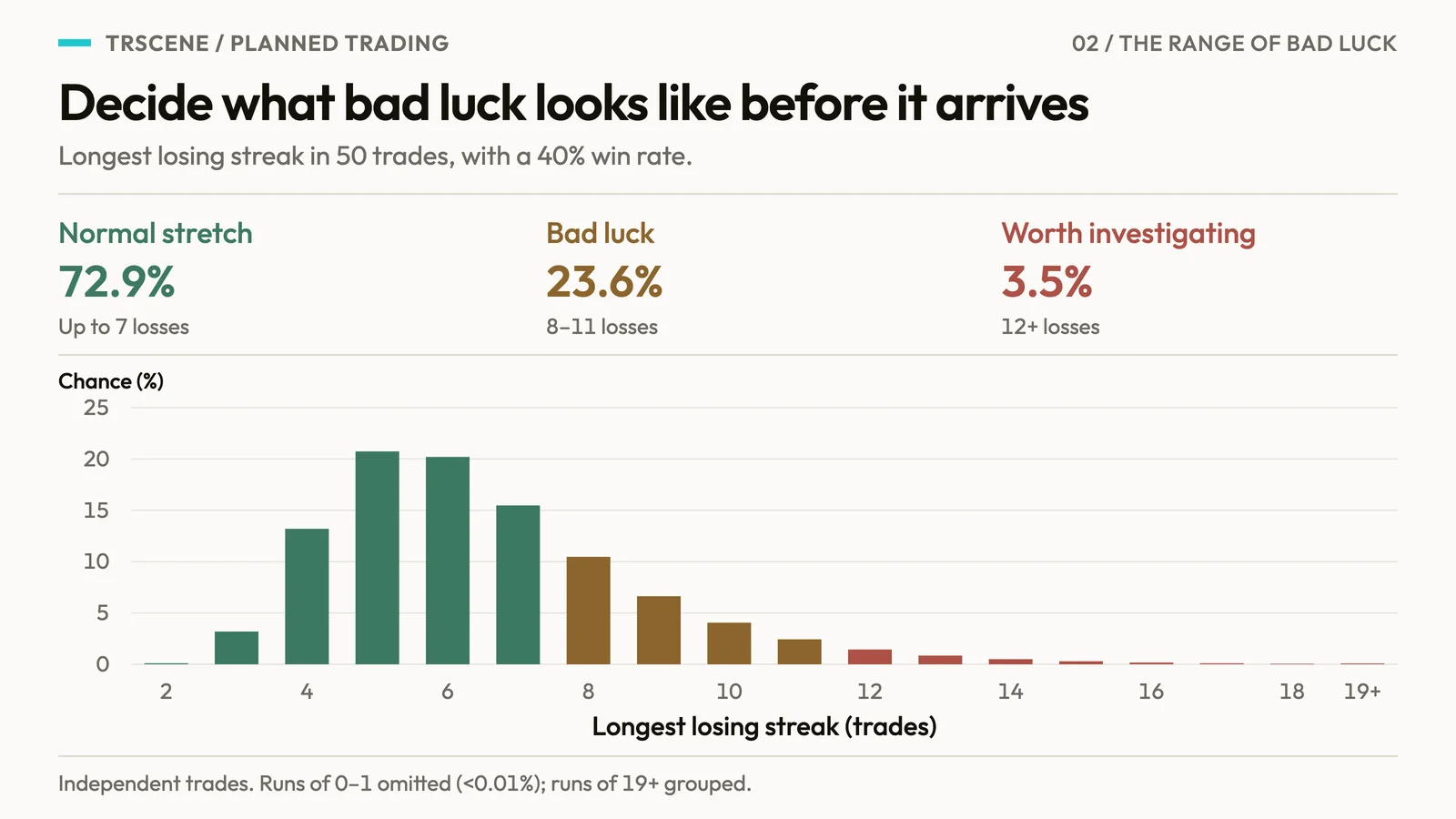
Decide in advance what bad luck looks like for your plan, so a losing streak doesn't decide for you.
Rules for changing the plan
If your review says the plan should change, the way you change it needs rules too. Otherwise, "reviewing the plan" becomes just another name for the moment from Part 4.
Change it only between trades. Never while you're holding a position. The moment you most want to change the plan is usually the moment you're most shaken.
Change it only after a set number of trades. For example, review every 30 trades. Changing the plan after one painful loss isn't a review. It's a reaction.
Change one thing at a time. Move the stop, the target, and the entry condition all at once, and even if the next record improves, you won't know why.
Write down the reason and the date. Give the plan a version number: version 1, version 2. The record has to be split by version before you can compare two versions.
Change it because of the record, not the last trade. "Last time this happened, so..." is just resulting in another form.
A 20-minute weekly review
Review only helps once it's a habit. Once a week, 20 minutes is enough.
- Collect. List this week's trades, one line each, with results in R.
- Score the execution. For each trade, mark yes or no for "Did I follow the plan?" If no, note how you broke it and what the voice in your head said.
- Sort them into the four boxes. Look especially for lucky mistakes.
- Check the numbers. Compare your running win rate, average win and loss in R, and longest losing streak with the plan's normal range.
- Make one decision. Keep going, change one thing (the next version), or cut your risk and take a break. Pick only one.
Set your goals the same way. "Make 10% this month" isn't a goal you control. The market and luck decide the outcome together. "An execution score of 90% or higher this month," "zero unplanned stop changes," and "a review every single week" are goals you do control. Make the things you can control your goals, and you can judge yourself fairly by whether you met them.
The point of the review isn't to change this week's profit and loss. It's to make your next 50 trades run on a slightly better plan, executed a little more precisely, than your last 50.

Twenty minutes a week, judged on what you control.
Using TRScene records to judge the plan
The biggest obstacle to asking the two questions separately is execution. When execution wobbles, you can't tell whether the record reflects the plan or the moment. In TRScene, the scenario itself is the plan. While the app is open on an awake, online computer, it carries out that flow as written. The closer your execution matches your plan, the more your record becomes a record of the plan itself.
When a run ends, each trade leaves a record and a report of what was executed, when, and how, so you can put the plan and the reality side by side. The Analytics screen shows your win rate and your average win divided by your average loss for the trades in the period you select, a starting point for step four of the weekly review. For R-based numbers per plan, note each trade's risk and keep each version's trades together.
Whether a plan is good is still your call. The record is there so that call rests on what the plan actually did, not on how the last trade felt.
After your next trade
When your next trade is over, answer the first two lines before you look at the profit and loss. Then use the result and your record for the rest.
- Did I follow the plan? If not, where did I break it? (Execution)
- What did the voice in my head say? (The moment)
- Which of the four boxes does this trade belong in? (Four boxes)
- Is my record so far within the plan's normal range? (Normal range)
- If I change the plan, am I changing one thing, between trades? (Rules for change)
The market decides the outcome. You decide the plan and the execution. Judge yourself by what you decide. Then even a good loss has something to teach, and even a lucky win shows you something to fix.
Judge the plan, not the outcome.
Planned Trading series
- Previous: Part 4: Your Plan Wasn't Wrong. The Moment Was.
- Start from the beginning: Part 1: Don't Predict. Prepare.
This article explains a trading approach for educational purposes and is not investment advice. The numbers in it are illustrative examples, and the losing-streak and win-rate probabilities assume each trade's outcome is independent. Crypto futures and leveraged trading can lead to large losses in a short time, so only trade with money you can afford to lose.